 ultimate-guide
Sustainable Ground Transportation Options for Businesses
Quick Summary
Sustainable ground transportation is any way people and clients move on the ground that reduces emissions, fuel use and waste while still arriving on time. For businesses, it means choosing the right mode for each trip, such as transit, shared rides, shuttles or electric vehicles.
- Match the transport mode to each trip type rather than defaulting to a single car.
- Full vans carrying several passengers usually beat multiple solo trips on emissions per passenger.
- Scheduling and consolidation often deliver bigger gains than buying a single hybrid vehicle.
- Measure a baseline of trips, distance and occupancy before changing your program.
- Model total cost of ownership, including charging infrastructure, when evaluating electric vehicles.
Table of Contents
- What Sustainable Ground Transportation Means for a Business
- Sustainable Transportation Examples by Trip Type
- Sustainable Public Transportation for Employee Commuting
- Electric Vehicles for Business Transportation: Costs, Charging and Readiness
- Shared Rides, Shuttles and Private Car Service Compared
- Measuring Emissions and Total Cost Before You Switch
- Writing a Sustainable Transportation Policy for Employees
- Choosing Your Next Ground Transportation Step with Regal Limousine
- Frequently Asked Questions
What Sustainable Ground Transportation Means for a Business
Last Updated: November 6, 2026
Sustainable ground transportation is any way your people and clients move on the ground that cuts emissions, fuel use and waste while still getting them there on time. For a business, that means choosing the right mode for each trip rather than defaulting to a single car or a single habit.
Sustainability in ground transport rests on three ideas. The first is mode choice: walking, cycling, transit, shared rides and electric vehicles all have different footprints. The second is occupancy: a full van moving eight people usually beats eight solo trips in terms of emissions per passenger. The third is operational discipline, meaning right-sized vehicles, efficient routing and fewer empty miles.
A common mistake is treating sustainability as a single purchase, such as buying one hybrid. In practice, the biggest gains often come from scheduling and consolidation, not from the vehicle itself.
U.S. Environmental Protection Agency transportation emissions overview
Sustainable Transportation Examples by Trip Type
Most business trips fall into a handful of patterns, and each pattern suggests a different option. Short intra-office trips often suit walking or cycling. Commutes within a metro area often suit transit or carpooling. Airport runs and executive travel usually require a higher service level, which is where chauffeured vehicles, including electric and hybrid models, fit best.
Matching mode to trip type is the simplest way to build a sustainable program. A decision framework might look like this:
| Trip Type | Typical Sustainable Option | Main Trade-off |
|---|---|---|
| Short distance, under 2 miles | Walking or cycling | Weather, time |
| Daily employee commute | Transit, carpool, vanpool | Flexibility |
| Group event or offsite | Shuttle or motorcoach | Scheduling |
| Airport transfer, executive | Hybrid or electric chauffeured car | Booking lead time |
| Multi-stop client day | Consolidated private car service | Cost per trip |
Use this table as a starting point, then adjust for your own volume and budget.
Sustainable Public Transportation for Employee Commuting
Public transit can be a lower-emission option per passenger for commuting, especially where many riders share one vehicle. Employers can check transit data from the U.S. Department of Transportation to gauge local options.
Employers can support transit use with transit benefit programs, flexible schedules that avoid crowded peak times, and clear information about routes. Few programs fail for lack of vehicles; they fail because employees do not know the options exist.
U.S. Department of Transportation transit data
Electric Vehicles for Business Transportation: Costs, Charging and Readiness
Electric vehicles reduce tailpipe emissions and often lower fuel and maintenance costs, but readiness matters more than enthusiasm. Our guide explains how to book airport car service in advance when you are scheduling vehicles. Electrification is often best treated as an infrastructure and operations project rather than only a vehicle purchase.
Total cost of ownership, not sticker price
Compare an EV against an equivalent gasoline or hybrid vehicle on total cost of ownership over the intended holding period. The line items that matter most are:
- Acquisition or lease cost. Purchase price or monthly lease payment, net of any incentive the business or lessor qualifies for. Confirm current terms with the dealer, lessor, or a tax advisor.
- Fuel or energy. Electricity per mile can be lower than gasoline per mile, but the actual figure depends on your local utility rate, whether you charge at off-peak hours, and whether you rely on public fast charging, which costs more per kilowatt-hour than depot charging.
- Maintenance. EVs have fewer moving parts and no oil changes, but tires, brakes, cabin filters, and coolant still need service, and high-voltage system repairs require trained technicians.
- Charging infrastructure. This is the most commonly underestimated cost. Budget for hardware, electrical panel or service upgrades, conduit and trenching, permitting, and installation. A single Level 2 charger at a small office is a modest project; a depot with multiple chargers and load management is a capital project.
- Insurance and registration. Premiums vary by vehicle and carrier; some jurisdictions may charge additional registration fees for EVs.
- Driver and downtime costs. Time spent charging during the workday is a real operating cost for chauffeured and shuttle operations.
Request current quotes from vendors and your utility rather than relying on published estimates, because pricing varies widely by region, vehicle class, and electrical service.
Charging and operational readiness
Before committing, answer four operational questions:
- Does the route fit real-world range? Published range figures assume ideal conditions. Cold weather, highway speeds, payload, and climate control reduce range. Plan routes around a conservative range estimate, not the sticker number.
- Where will vehicles charge, and for how long? Overnight depot charging is the cheapest and most convenient pattern for fleets that return to base. Vehicles on the road all day need either a return-to-base window or access to public fast charging, which adds time and cost.
- What is the contingency plan? Identify backup charging locations, a plan for vehicles that arrive with low charge, and a fallback vehicle for days when a charger is down or a route runs long.
- Who is trained? Drivers need to know how to plug in, how to use public charging networks, how to plan routes around charging stops, and what to do if a charger is unavailable.
Watch out: buying EVs before confirming your electrical service capacity can stall a program for months while you wait on utility upgrades and permits.
Incentives and the practical path
Incentives for vehicles and charging equipment exist but change frequently, so confirm current eligibility with the relevant official source. Confirm current eligibility before you build a budget around a credit.
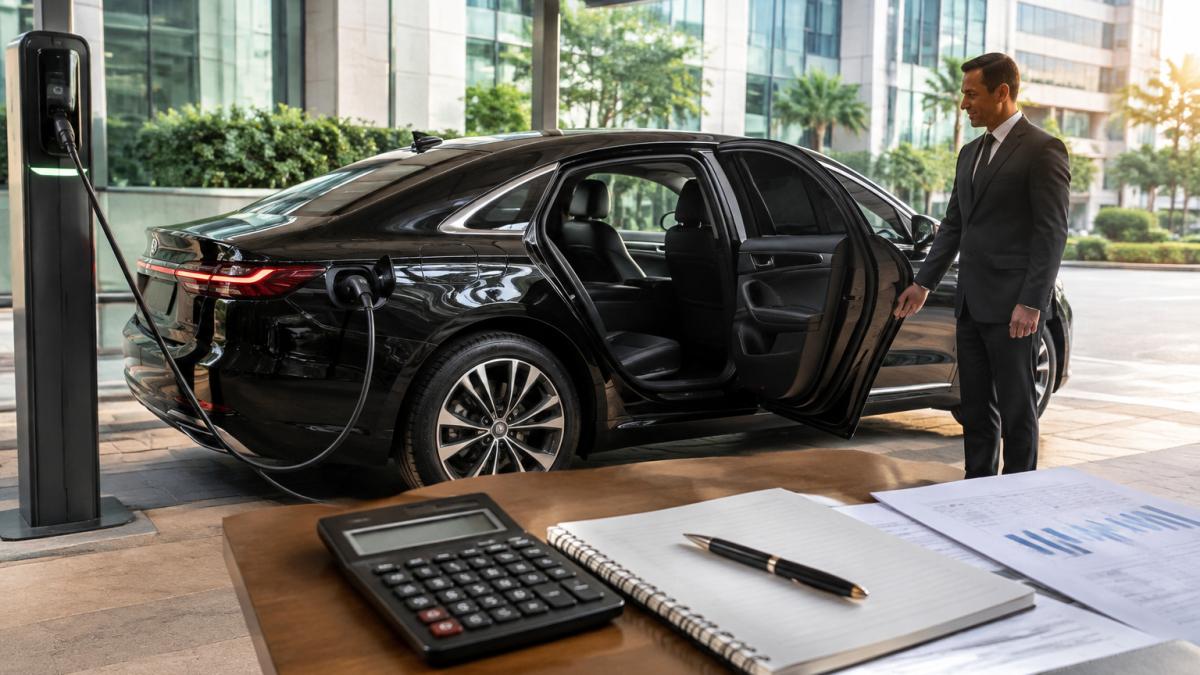
!A sleek black sedan charging at a covered curbside station outside a modern South Florida office building, with a professional driver standing beside the open rear door
Shared Rides, Shuttles and Private Car Service Compared
Shared rides, shuttles and private car service sit at different points on the efficiency-service curve. Shared options spread emissions across riders but can add travel time. Shuttles suit predictable group movements. Private car service offers control over timing and comfort.
Compare these options on occupancy, schedule flexibility and service level.
For a deeper look at how managed booking differs from booking independently, see our guide to managed travel vs booking independently for business.
Measuring Emissions and Total Cost Before You Switch
Measure before you change anything. Most sustainability programs stall because they cannot show whether a change actually reduced emissions or cost. A defensible baseline and a consistent calculation method solve that problem, and they are the part competitors most often skip.
Build a trip-level baseline
Start by logging a representative month of ground transportation activity. For each trip or trip category, record:
- Trip type (commute, airport transfer, client visit, group event, freight or courier run)
- Distance traveled
- Mode and vehicle type
- Number of passengers or, for freight, cargo weight
- Who paid and how it was booked
A spreadsheet with these columns is enough to start. The goal is a repeatable record you can update monthly, not a one-time audit.
Calculate emissions per passenger-mile or ton-mile
The standard approach is to multiply distance by an emission factor for the mode and fuel type, then divide by occupancy to get emissions per passenger-mile. For freight, divide by ton-miles instead. Official sources such as the U.S. Environmental Protection Agency publish emission factors that support this calculation.
Two considerations matter:
- Occupancy changes the answer. A van carrying eight passengers has far lower emissions per passenger-mile than the same van carrying one. Always divide by actual passengers, not vehicle capacity.
- Use one method consistently. If you change emission factors or calculation methods mid-year, restate prior figures or disclose the change. Otherwise your progress claims are not comparable.
EPA greenhouse gas equivalencies and emission factors
Compare total cost alongside emissions
Emissions tell half the story. Build a parallel cost column for each mode that includes fuel or energy, maintenance, insurance, driver time, booking overhead, and any parking or tolls. For owned or leased vehicles, include the acquisition or lease cost amortized over the holding period. For chauffeured and shuttle services, the vendor invoice is the cost, but compare it against the fully loaded cost of the alternative, including employee time spent driving and parking.
A simple baseline table helps leadership see the trade-offs clearly:
| Mode | Monthly trips | Passenger-miles | Estimated emissions | Total monthly cost | Cost per passenger-mile |
|---|---|---|---|---|---|
| Solo car commute | |||||
| Vanpool or shuttle | |||||
| Transit | |||||
| Chauffeured airport transfer |
Fill the table with your own data, then model the change. Avoid claiming reductions you have not calculated, and state your assumptions (emission factors, occupancy, holding period) wherever you present results.
Report progress consistently
Pick a reporting cadence, such as quarterly, and report the same metrics each time: total passenger-miles, emissions per passenger-mile, total cost, and cost per passenger-mile. Note any changes in method. Consistent reporting helps make a program credible to leadership and stakeholders.
For companies that bill executive transport centrally, our guide to corporate billing for executive transportation explains how to set up cost tracking that makes this measurement easier.
EPA greenhouse gas equivalencies and emission factors
Writing a Sustainable Transportation Policy for Employees
A written policy turns good intentions into consistent behavior. Keep it short and specific. Define which modes are preferred for which trip types, who approves exceptions, how bookings are made, and how employees are reimbursed. State the goal, such as reducing single-occupant trips, and name the metric you will review.
A workable structure includes a purpose statement, a trip-type matrix, booking rules, approval thresholds and a review date. Revisit the policy annually with fresh data.
For companies that rely on company-managed rides, our overview of a detailed drivers alternative for corporate travel shows how chauffeured programs are structured within a policy.
Choosing Your Next Ground Transportation Step with Regal Limousine
Start with one measurable change: consolidate airport transfers into a managed program, or move a recurring group trip to a single shuttle. Small, tracked steps reveal what works before you scale. If your executive and airport trips are a large share of your ground spend, that is usually the highest-impact place to start.
Regal Limousine provides premium chauffeured car services for corporate travel and airport transfers across South Florida, with a quick booking process. Before you commit to a program, check our Palm Beach Gardens service area to confirm coverage near your offices, then book your ride in seconds.
Frequently Asked Questions
What are some examples of sustainable transportation options for businesses?
Common examples include electric and hybrid vehicles, public transit passes for employees, bicycle programs for short trips, carpooling and shared rides, and shuttle services that carry several passengers at once. The right mix depends on trip length, passenger count and how often trips occur. Companies often start by reviewing their most frequent routes, such as airport transfers or client meetings, and matching each one to the option that cuts emissions without slowing the trip down.
How should a business compare private car service and rideshare for sustainability?
Compare vehicle type, occupancy and fleet age rather than the brand name alone. A rideshare trip with one passenger in a standard gasoline car may produce more emissions per person than a full shuttle or a chauffeured vehicle running a fleet of newer, lower-emission cars. Ask providers what vehicles they run, how they group trips and whether they report emissions. Use the same measure for every option so the comparison stays fair.
What should a sustainable ground transportation policy include?
A useful policy names the approved transport modes for each trip type, sets preferences such as public transit or shared rides for local travel, and defines when a private or executive vehicle is justified, such as for time-sensitive airport transfers or VIP clients. It should also describe how bookings are made, how emissions are tracked and who approves exceptions. Reviewing the policy once a year keeps it aligned with new vehicle options and changing travel patterns.