 listicle
10 Tips for Navigating Miami International Airport
Table of Contents
- 1. Arrive Early and Use Flight Tracking to Beat Congestion
- 2. Understand Terminal Layout and Concourse Navigation
- 3. Manage MIA Airport Security Wait Times Strategically
- 4. Master the Best Luxury Airport Transfer in Miami
- 5. Use Airport Mobile Apps for Real-Time Wayfinding
- 6. Navigate Ground Transportation: How to Get from MIA to Downtown
- 7. Plan Baggage Claim and Luggage Assistance Routes
- 8. Optimize Connection Time for Layovers and Transfers
- Frequently Asked Questions
Last Updated: September 28, 2026
Navigating Miami International Airport can feel like running a gauntlet. Long security lines, confusing terminal layouts, crowded concourses, and the constant pressure to reach your gate on time create stress that lingers long after you've landed. If you're traveling through one of the busiest hubs in the country, the challenge multiplies. That's where strategy matters. The right approach to navigating Miami International Airport transforms a potentially chaotic experience into a smooth, predictable journey.
Whether you're a frequent business traveler or someone making an occasional trip, these 10 tips will help you move through the airport with confidence and efficiency.
1. Arrive Early and Use Flight Tracking to Beat Congestion
The single biggest mistake travelers make is underestimating how long things take at a major airport. Arriving just 90 minutes before a domestic flight sounds reasonable until you hit a security line that hasn't moved in 15 minutes.
Build in extra time, at least two hours for domestic flights, three for international departures. This buffer absorbs the unexpected: a longer security checkpoint queue, a missed exit sign, or a terminal connector that moves slower than you anticipated.
Use your airline's mobile app or a flight tracking service to monitor conditions in real time. Many apps show current security wait times at specific checkpoints. If one line is backed up, you can often switch to a less crowded checkpoint. This small adjustment can save 20-30 minutes.
2. Understand Terminal Layout and Concourse Navigation
The airport has multiple terminals, and knowing which one you're in matters before you even arrive. Each terminal connects to different concourses, and moving between them takes time. Check your boarding pass or airline confirmation to confirm your terminal assignment.
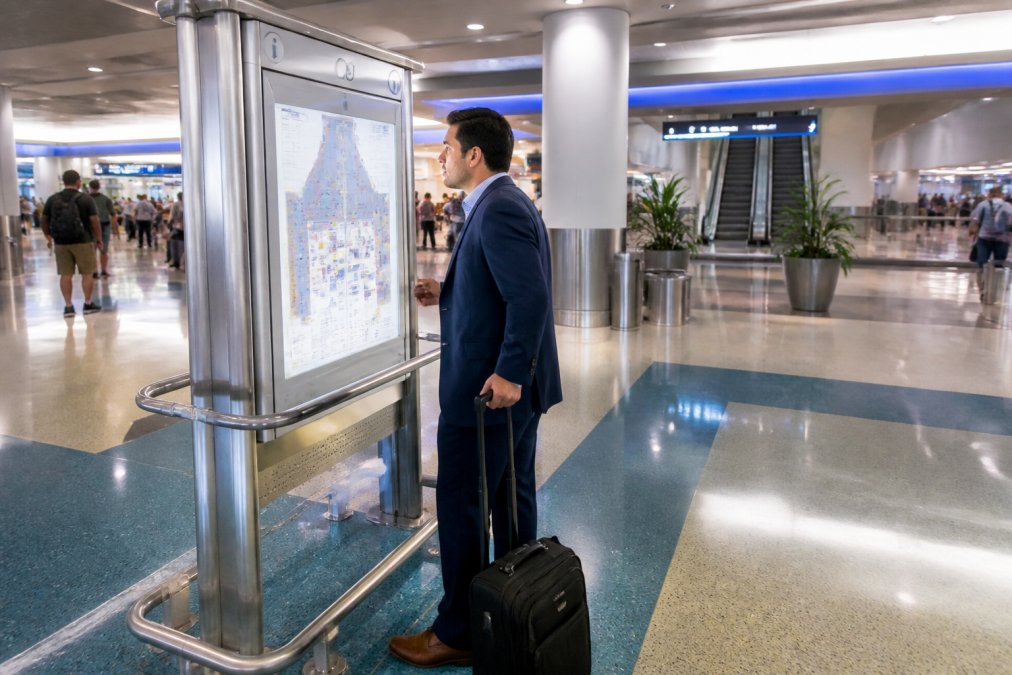
Once you're inside, the layout becomes your navigation tool. Terminal maps are posted at entrances and near security exits. Take 30 seconds to study the map and identify your concourse and gate area. Most concourses run in a linear or circular pattern, making navigation straightforward once you understand the layout.
The terminal connector, a free automated people mover system, links key areas of the airport, including the rental car center and Metrorail connections. If you need to move between distant concourses, the connector saves significant walking time compared to navigating hallways.
3. Manage MIA Airport Security Wait Times Strategically
Security checkpoint congestion is predictable if you know when to expect it. Early morning (5:00-7:00 AM) and midday (11:00 AM-2:00 PM) tend to see higher volumes. Late evening (after 6:00 PM) typically offers shorter waits.
If you have flexibility in your departure time, choose a flight during a less congested window. If your flight time is fixed, arrive early enough that even a 20-minute security line won't threaten your departure.
Have your ID and boarding pass ready before you reach the checkpoint. Remove your shoes, belt, and jacket in the security area, don't wait until you're at the scanner. These small efficiencies move lines faster and reduce your personal wait time.
Consider TSA PreCheck or Clear if you travel frequently. TSA PreCheck costs around $78-85 for five years and speeds up security screening significantly. Clear, a separate service, allows you to skip the ID verification line entirely for a premium fee. Many frequent travelers find these investments worthwhile.
4. Master the Best Luxury Airport Transfer in Miami
Getting to and from the airport shouldn't add stress to your trip. This is where a reliable chauffeured service makes a tangible difference. Rather than navigating parking, rental car procedures, or waiting for a ride-share vehicle, a professional airport transfer handles the logistics while you focus on your travel.
Regal Limousine specializes in seamless airport transfers across South Florida. Our chauffeured service means you arrive at your destination on schedule, without the uncertainty of ride-share wait times or the hassle of rental car processes. Our drivers know the airport layout, the best routes to downtown and surrounding areas, and how to navigate traffic patterns that shift throughout the day.
The booking process takes seconds through our platform. You select your pickup time, destination, and vehicle preference, then a professional driver handles the rest. For corporate travelers managing multiple trips weekly, this efficiency compounds quickly. No more manual bookings, no more uncertainty about driver reliability.
5. Use Airport Mobile Apps for Real-Time Wayfinding
Your smartphone is your best wayfinding tool at a major airport. Download your airline's app before you travel. Most major carriers now display real-time gate information, security wait times, and terminal maps directly in their apps.
Beyond your airline app, the airport's official app provides terminal maps, restaurant locations, retail stores, and live flight information. Some apps include augmented reality wayfinding features that overlay directions onto your phone's camera view, essentially GPS navigation inside the terminal.
Google Maps works inside terminals too. Search for your airline's gate area or a specific restaurant, and the app will route you through the concourse. This is particularly useful if you need to find a specific gate quickly or locate a meal option before boarding.
Check these apps before you pass through security. Gate assignments often change, and knowing this in advance prevents the frustration of arriving at your assigned gate only to discover the flight has moved.
6. Navigate Ground Transportation: How to Get from MIA to Downtown
Once you've landed, your next decision is how to reach your final destination. Multiple options exist, each with different tradeoffs between cost, convenience, and travel time.
The MIA Mover is a free automated people mover connecting the terminal to the rental car center and Metrorail station. If you're heading downtown or to another location served by Metrorail, this is the most economical route. Metrorail fares start at $2.25 per ride, making it the cheapest option for urban destinations (miamidade.gov). The tradeoff is travel time, Metrorail typically takes 30-45 minutes to reach downtown depending on your exact destination.
Ride-share services like Uber and Lyft offer door-to-door convenience. Wait times vary depending on demand, but you'll typically see a vehicle within 10-15 minutes during normal conditions. Pricing depends on traffic and surge demand, peak travel times can significantly increase fares.
A chauffeured service like Regal Limousine eliminates the variables. Your driver meets you at arrivals, handles your luggage, and drives you directly to your destination. No waiting for a vehicle to arrive, no surge pricing, no uncertainty about arrival time. For business travelers managing tight schedules or anyone traveling with clients, this reliability justifies the investment.
| Transportation Option | Cost Range | Travel Time | Best For |
|---|---|---|---|
| Metrorail + MIA Mover | $2.25 per ride | 30-45 minutes | Budget-conscious travelers heading downtown |
| Ride-share (Uber/Lyft) | Variable; surge pricing possible | 15-30 minutes | Solo travelers comfortable with app-based services |
| Rental car | Daily rates vary; parking fees apply | Immediate; traffic-dependent | Travelers needing flexibility and vehicle access |
| Luxury airport transfer | Professional rate | Predictable; optimized routing | Corporate travelers, VIP guests, reliability-focused travelers |
7. Plan Baggage Claim and Luggage Assistance Routes
Baggage claim can create bottlenecks, especially during peak arrival times. As you exit the secure area after landing, check the airport's signage or your airline app to identify which baggage carousel your luggage will arrive at. This prevents aimless wandering.
Baggage carousels are grouped by airline and flight, so knowing your carousel number before you reach baggage claim saves time. Arrive at your carousel a few minutes before your flight number appears on the overhead display, luggage usually begins circulating within 15-20 minutes of plane arrival.
If you're traveling with multiple large bags or have mobility concerns, luggage assistance services are available.
8. Optimize Connection Time for Layovers and Transfers
Layovers create a unique navigation challenge. If your connection time is tight, under 90 minutes, you're in a race. If it's generous, three hours or more, you have options beyond rushing through the concourse.
Frequently Asked Questions
How early should I arrive at Miami International Airport before my flight?
For domestic flights, arrive 2 hours before departure; for international flights, arrive 3 hours early. Arriving early gives you time to navigate the concourse, clear security checkpoints, and account for unexpected congestion. Flight tracking apps help you monitor real-time delays and adjust your arrival time if your inbound connection is running late.
What are the typical MIA airport security wait times, and how can I reduce them?
Security wait times at Miami International Airport typically range from 15 to 45 minutes during peak hours (6-9 a.m. and 4-7 p.m.). Use TSA PreCheck or CLEAR to bypass standard security lines. Check the airport's mobile app for real-time wait times before you arrive. Off-peak travel times and arriving early also help you clear security faster.
How do I find the best luxury airport transfer in Miami?
Professional chauffeured services like Regal Limousine offer fixed pricing, real-time flight tracking, and meet-and-greet services at baggage claim. Choose a service that provides reliable drivers, seamless booking, and flexibility for flight delays. Luxury transfers eliminate stress and ensure you arrive at your destination on time, making them ideal for business travelers and VIP guests.
What's the easiest way to get from MIA to downtown?
The MIA Mover connects the terminal to Miami Airport Station free of charge. From there, take Metrorail (fixed fare of $2.25) directly to downtown. Alternatively, book a professional chauffeur service for a direct, comfortable route without transfers. Ride-share services are available but subject to traffic congestion on local highways.
Are there digital tools to help me navigate Miami International Airport?
Yes. The official Miami International Airport mobile app provides real-time flight tracking, terminal maps, wayfinding directions, security wait times, and restaurant and retail locations. Many airlines also offer apps with gate information and boarding pass details. Using these tools before arrival helps you plan your route and anticipate congestion points.